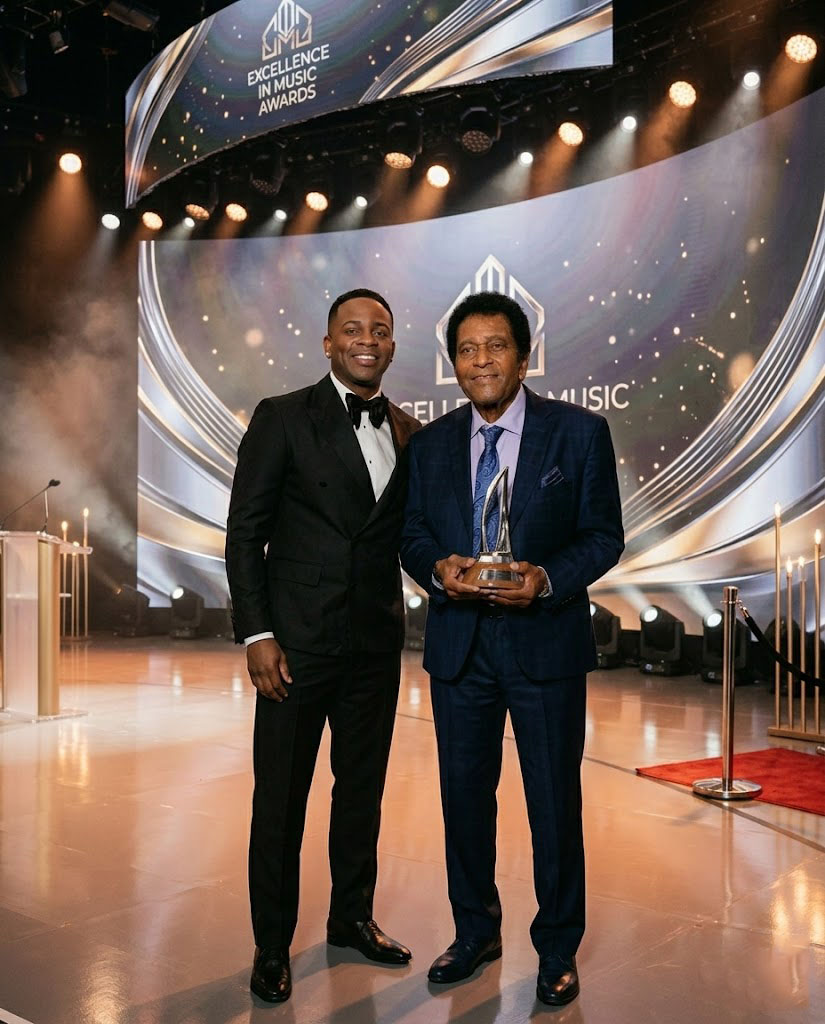
29 NUMBER ONE HITS AND A LIFETIME OF BROKEN BARRIERS — BUT ON HIS VERY LAST STAGE, HE REFUSED TO STAND IN THE SPOTLIGHT ALONE…
On November 11, 2020, an eighty-six-year-old Charley Pride walked slowly onto the CMA Awards stage to accept a lifetime achievement trophy. It was meant to be a standard industry celebration. It was a polite nod to a trailblazer who had quietly rewritten the rules of American music.
But Charley turned a routine television broadcast into something completely different.
He didn’t perform his greatest hit in isolation. Standing directly beside him was Jimmie Allen, a young Black artist navigating the very same industry road that Charley had brutally carved out five decades earlier.
To understand the gravity of that single performance, you have to look back at the quiet defiance of his entire life.
He was a man who started picking cotton in Sledge, Mississippi, at just seven years old, knowing the dirt roads offered no easy way out. He spent his youth pitching in the Negro Leagues, chasing a professional baseball dream that fate ultimately decided to withhold.
But he carried a secret weapon. He possessed a warm, unmistakable baritone voice that felt like a steady hand on a restless shoulder.
Nashville in the nineteen sixties was a walled city. It was a fiercely traditional landscape that had never seen a mainstream star who looked like Charley. The executives were terrified of how rural audiences would react. Early on, his records were shipped to radio stations without a photograph, letting the voice do the impossible work of changing minds before quick judgments could be made.
When audiences finally saw him step up to the microphone, there was often a tense, heavy silence. But by the time the first chorus ended, he had won them over completely.
He didn’t fight the prejudice with loud anger or bitter resentment. He simply sang.
He stacked up twenty-nine number-one hits. He won the coveted Entertainer of the Year award. He forced a divided nation to sit down, shut up, and listen to the sheer undeniable truth in his vocal delivery.
THE QUIET CONFESSION
Yet, on that crisp November night in two thousand and twenty, the aging pioneer did not hide behind the heavy armor of his legendary status.
He held the glass trophy. He looked out into the cavernous, socially-distanced room, and offered a moment of absolute, startling honesty.
“I’m nervous as can be,” he told the quiet crowd.
It was a stunning admission from a man who had stared down unimaginable hostility throughout his early career. At eighty-six, with nothing left to prove to anyone on earth, the music still moved him enough to make his hands shake.
Then, the familiar intro to “Kiss an Angel Good Mornin'” began to play.
Charley did not dominate the song. He didn’t try to remind the world of his towering vocal power. Instead, he gently shared the verses, stepping back to let Jimmie Allen shine. He watched the younger man sing with a proud, silent gaze that carried the heavy weight of fifty years of history.
It was not merely a duet. It was a quiet anointing.
Thirty-one days later, the music stopped.
Complications from a devastating virus took him just before the year could end. The voice that had comforted millions was abruptly silenced, leaving the country music community in a sudden, breathless shock.
He did not walk out under those bright television lights knowing it would be his final public bow. He was simply doing what he had always done—showing up, doing the quiet work, and sharing the music.
But sometimes, the universe scripts an ending more perfectly than any writer ever could.
The man who spent a lifetime forcing the heaviest doors open made absolutely sure to hold one open for the next generation, right before he stepped into the dark…