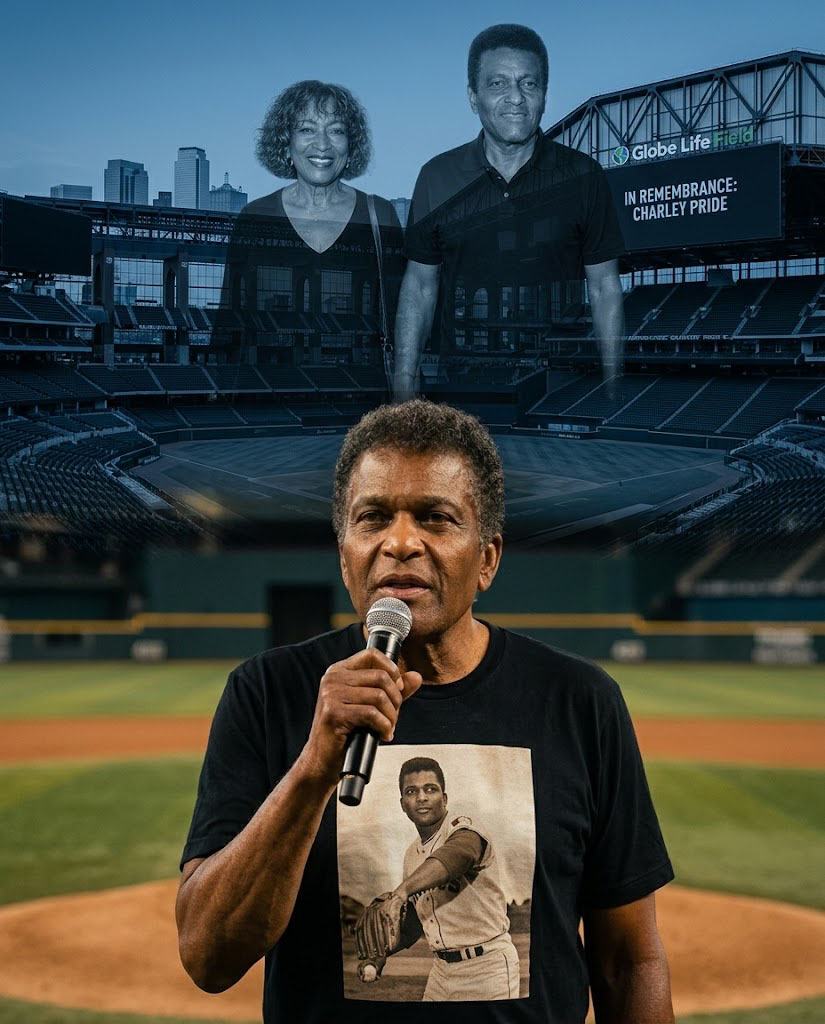
40,000 EMPTY SEATS. ONE 86-YEAR-OLD LEGEND ON THE MOUND. AND A FAREWELL NO ONE KNEW WAS HAPPENING…
In July of 2020, Charley Pride walked slowly onto the dirt of Globe Life Field in Texas. He did not come to throw out a ceremonial first pitch.
He stepped to the microphone to sing the national anthem.
There was no applause rolling down from the upper decks. There were no families waving flags or a massive crowd rising together in a familiar pregame ritual.
The pandemic had brought the world to a quiet halt. There was just an eighty-six-year-old man standing alone at the center of a monumental arena, his voice echoing through tens of thousands of vacant seats.
THE WEIGHT OF THE DIRT
Charley Pride was not just a smooth baritone on a country radio dial. He was a man who quietly rearranged the boundaries of American history.
Long before he became a country music icon with twenty-nine number-one hits, he was just a young man from Sledge, Mississippi, chasing a completely different dream. He wanted to be a baseball player.
He pitched in the Negro Leagues during a deeply divided era.
The baseball diamond was supposed to be a place of pure merit. But history had made it complicated, keeping men like him on the outside looking in. The pitcher’s mound represented both an ultimate possibility and a painful exclusion.
Eventually, the baseball dream faded. He traded his worn leather glove for a guitar.
He walked onto country music stages—places that had never seen anyone who looked like him—and simply refused to be ignored. He did not force the doors open with anger or demands.
He opened them with undeniable excellence.
THE QUIETEST VICTORY
Decades later, the boy who was once kept out of the game stood dead center in it. He was now a co-owner of the Texas Rangers.
He had conquered the institutions that once questioned his belonging. But on that summer afternoon, there was no crowd to witness the poetry of his return.
For many performers, an empty stadium might feel like a tragedy. For Pride, it felt entirely fitting.
His greatest battles had always been fought in the quiet. Early in his career, audiences would often go completely silent when he first stepped onstage, unsure of what to make of him.
He would just smile. He would offer a small nod. Then he would sing.
By the time the song ended, the silence would break into a roaring ovation. That was always his way.
But on that July afternoon, the silence stayed.
He took a quiet breath, squared his shoulders, and let his warm voice fill the massive, empty Texas sky. He sang the lyrics with the hard-earned gratitude of a man who had seen America at its most unfair, yet still believed in what it could become.
He wasn’t performing for a television broadcast. He was singing for the ghosts of the game, for the long miles he had traveled, and for the barriers he had outlasted.
Five months later, Charley Pride was gone.
Looking back, that silent July afternoon was never just a pregame song. It was a man making a final, quiet peace with a world that took a lifetime to accept him.
He did not need a roaring crowd to prove the size of his legacy, because sometimes the most powerful sound a pioneer can leave behind is a graceful silence…