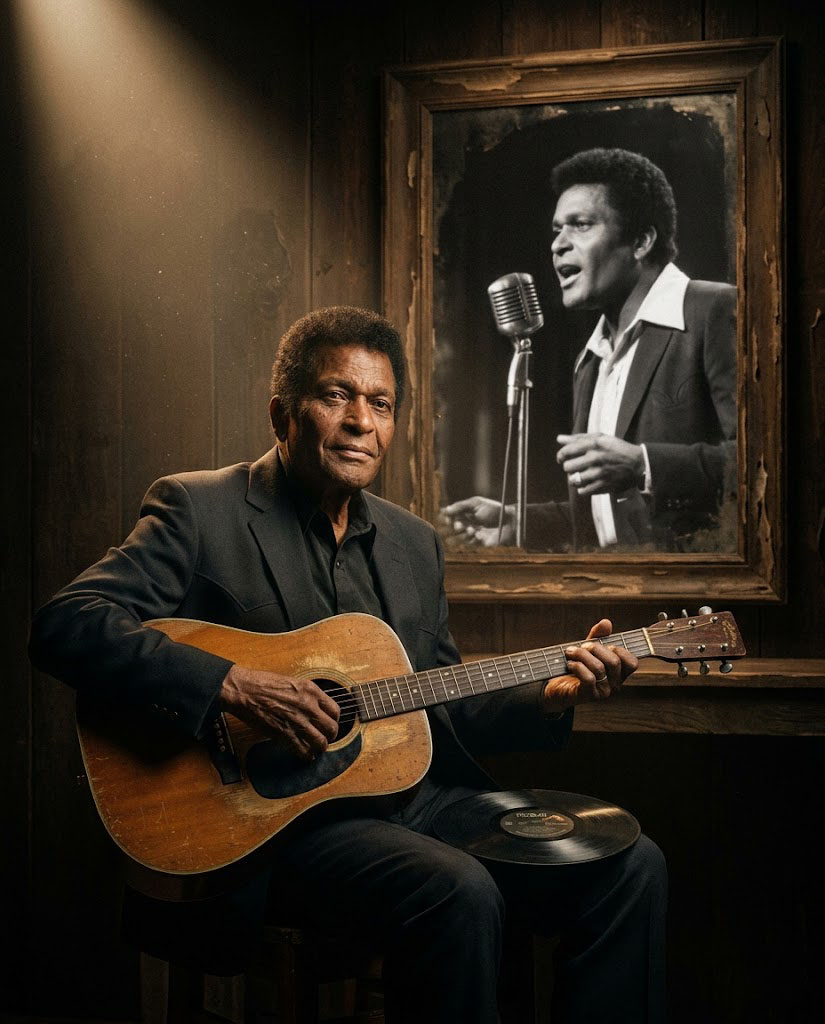
70 MILLION RECORDS SOLD AND A VOICE THAT QUIETLY OUTSHINED ELVIS PRESLEY, YET THEY PRAYED AMERICA WOULD NEVER ACTUALLY LOOK AT HIS FACE…
He never asked to be a pioneer.
Charley Pride was born in the heavy heat of Sledge, Mississippi, the fourth of eleven children in a family of sharecroppers. His hands were built for hard labor in the cotton fields, not for holding gold records. He dreamed of stadiums, but he wanted to hold a baseball bat, not a microphone.
For years, he chased the major leagues across dusty minor league diamonds.
But when baseball closed its doors on him, he turned to a cheap guitar he had ordered from a Sears catalog. He carried his velvet baritone into the clubs, singing between innings and long after the stadium lights went dark.
THE INVISIBLE KING
When he finally arrived in Nashville, he brought a voice that felt like home. It was warm, steady, and unmistakably honest. He belonged right next to Merle Haggard and George Jones.
He quietly became RCA Records’ biggest phenomenon.
Between 1969 and 1975, he dominated the country charts with an iron grip. Twenty-nine number-one hits echoed through truck cabs, diners, and living rooms across a deeply divided America.
He outsold John Denver.
For six consecutive years, he sold more records for the label than Elvis Presley himself.
But behind closed doors, the record executives were terrified.
They knew country music was a genre fiercely guarded by tradition. They knew what would happen if southern radio stations realized a Black man was singing their favorite ballads. So, the label made a decision that feels almost impossible today.
They erased his face.
They shipped his early promotional records to disc jockeys without a single photograph.
No portraits.
No album art.
Just a name pressed into cold black vinyl, sent into the world with a silent prayer.
THE QUIET DEFIANCE
The deception worked perfectly.
Radio stations played songs like “Just Between You and Me” on repeat. Millions of listeners fell in love with the music, projecting their own lives onto a singer they had never seen.
Then came the night RCA could no longer hide him.
He stepped out onto a stage in front of thousands of fans who thought they knew exactly who they were coming to see. When the spotlight hit him, the room changed.
The applause faltered.
A sudden, heavy quiet fell over the venue. Some venue owners braced for a riot, terrified of the backlash staring them in the face. The crowd leaned forward, waiting for something they didn’t yet understand.
And then—
He didn’t argue.
He didn’t make a grand speech about race or rights. He simply offered a small nod to the band, stepped up to the microphone, and began to sing.
THE ECHO
Within minutes, the tension melted into the floorboards.
His performance was so calm, so undeniably pure, that the audience forgot their prejudice and simply listened. He disarmed a hostile world with nothing but the quiet dignity of his craft.
Today, it is a strange tragedy that his name often slips out of the modern conversation. New generations memorize the legends of Johnny Cash and Willie Nelson, while the man who outsold them all fades into the background.
But the music remains.
He broke the tallest barriers without ever raising his voice in anger.
He proved that true greatness doesn’t need to demand attention, it only needs to be heard…