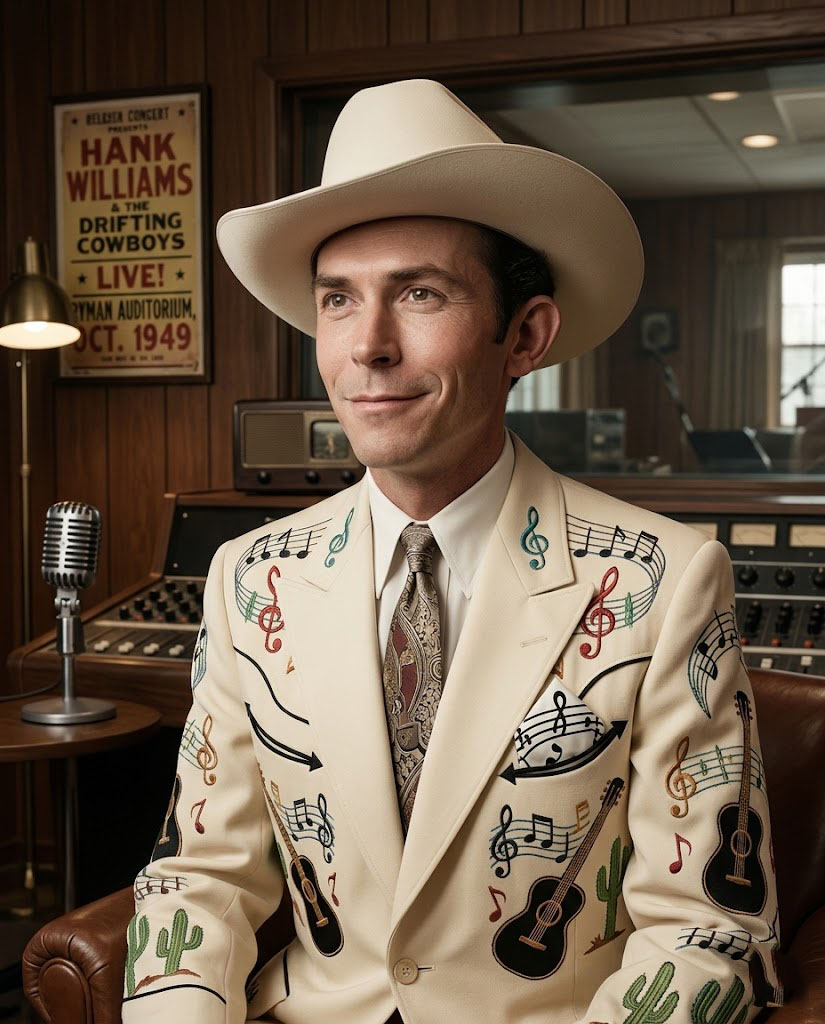
Please scroll down for the music video. It is at the end of the article! 👇👇

“HEAR THAT LONESOME WHIPPOORWILL…” — HANK WILLIAMS TURNED LONELINESS INTO SOMETHING PEOPLE COULD FINALLY HEAR…

When Hank Williams wrote “I’m So Lonesome I Could Cry” in 1949, he was not chasing a hit record.

He was trying to describe a feeling most people never fully admit out loud.

The song arrived quietly. No dramatic opening. No grand declaration. Just a lonely whippoorwill breaking the silence somewhere in the darkness.

“Hear that lonesome whippoorwill…”

And suddenly the entire room felt emptier.

Even decades later, the song still carries a strange stillness inside it — as if Hank Williams was not performing for an audience at all, but sitting alone in the middle of the night trying to survive his own thoughts long enough to make it until morning.

That honesty became its power.

Elvis Presley once called it the saddest song he had ever heard. He understood something important about it: Hank Williams did not write heartbreak like entertainment. He wrote it like weather closing in around someone with nowhere left to hide.

The imagery remains devastating in its simplicity.

A robin weeping.

A midnight train whining low.

A falling star lighting up the sky before disappearing forever.

None of it feels exaggerated.

That is what makes the loneliness unbearable.

THE MAN SURROUNDED BY PEOPLE WHO STILL FELT ALONE

By the late 1940s, Hank Williams had already become one of country music’s defining voices. Crowds packed dance halls to hear him sing. Radio stations leaned heavily on his records. America recognized the sound of his pain almost immediately because he delivered it without polish or distance.

But fame did not protect him from isolation.

If anything, it deepened it.

Hank Williams often lived inside a painful contradiction: surrounded constantly by audiences, musicians, radio hosts, and admirers while privately drifting further into loneliness few people around him fully understood. Illness, exhaustion, addiction, and troubled relationships slowly followed him through the years his fame grew brightest.

“I’m So Lonesome I Could Cry” sounded prophetic even when he first recorded it.

Not because it predicted tragedy.

Because it understood emptiness too clearly already.

Most singers perform sadness outwardly, reaching for emotional effect. Hank Williams did something quieter and far more unsettling. He sounded like someone speaking softly from inside the loneliness itself, without confidence it would ever fully leave him.

That difference changed country music forever.

The song did not ask listeners to admire sorrow poetically.

It asked them to recognize themselves inside it.

THE SONG THAT NEVER STOPPED ECHOING

Over time, “I’m So Lonesome I Could Cry” became more than one of Hank Williams’ greatest recordings. It became part of the emotional foundation of American music itself. Artists from Elvis Presley to Johnny Cash carried the song forward because they recognized how completely it captured something universal and difficult to explain.

Not dramatic heartbreak.

Not temporary sadness.

The deeper loneliness that arrives quietly even while life around you continues moving normally.

That is why the song still stops people decades later. The world has changed endlessly since 1949 — louder music, faster lives, brighter distractions — yet the emotional truth inside Hank Williams’ voice remains untouched by time.

Because loneliness itself rarely changes.

It still arrives at night.

Still grows larger in silence.

Still makes ordinary sounds feel unbearably personal.

And perhaps that is why “I’m So Lonesome I Could Cry” never really became old-fashioned nostalgia. The song continues finding listeners during moments when they suddenly realize no crowd, no success, and no amount of noise can completely protect a human being from feeling alone sometimes.

Hank Williams understood that before most people had the language for it.

He did not just sing about heartbreak. He gave loneliness its own sound — soft enough to slip into the dark beside people who thought nobody else could hear what they were carrying…


Post view: 5

Related Post

HE WALKED ONTO THE Grand Ole Opry STAGE EXPECTING SILENCE — OR WORSE. In 1967, Charley Pride stood backstage holding his guitar while the sound of the audience drifted through the curtains. He knew exactly what the moment meant. A Black solo artist. Country music’s most sacred stage. An audience raised inside traditions that had rarely made room for someone like him. People had warned him before he ever stepped under those lights. Some questioned whether the crowd would accept him at all. Others feared the silence might be louder than boos — polite, cold, distant. The kind of silence that tells a person they were never supposed to be there. And even years later, Charley Pride admitted the truth quietly: “I just hoped they’d listen.” That was the fear he carried onto the Opry stage that night. Not failure. Not criticism. Rejection. When his name was announced, the applause sounded careful at first. Respectful, but uncertain. Pride walked to the microphone without drama, adjusted his guitar strap, and focused on the only thing he could fully trust: The song. Then he started singing. And little by little, something inside the room changed. Not instantly. Not magically. But steadily. His voice moved through the tension with a calm confidence that didn’t ask permission to belong there. Warm. Honest. Unmistakably country. The kind of voice that made people stop thinking about what they expected to see and start listening to what they were actually hearing. Pride later admitted he avoided looking too deeply into the audience during those first moments. He wasn’t sure what he might find staring back at him. But the applause kept growing. First after a verse. Then louder after the chorus. Then rising into something undeniable. That night became bigger than a performance, even though Charley Pride never treated it like a revolution. He didn’t step onto the Opry stage trying to challenge country music. He stepped onto it simply wanting to sing. And somehow, that quiet honesty changed the room more powerfully than anger ever could. Because what happened in 1967 wasn’t just about one artist being accepted. It was about an audience realizing country music sounded exactly like country music… even when the face holding the microphone challenged everything they thought the genre was supposed to look like. And when Charley Pride walked offstage that night, he didn’t leave behind silence. He left behind applause strong enough to make history shift a little closer toward something better.

BEFORE JOHNNY CASH WORE BLACK, MAYBELLE CARTER WAS ALREADY CHANGING THE SOUND OF AMERICA. And she did it with a Gibson guitar so large it nearly covered her whole body. Before Johnny Cash wore black, Maybelle Carter carried a Gibson L-5 into a recording session in Camden, New Jersey — a guitar bought on installments for $275 at a time when that kind of money could feed a family for months. Most people saw a guitar as background noise back then. Maybelle Carter heard something else. While other players strummed chords, she split the instrument in two. Her thumb carried the melody on the bass strings. Her fingers brushed rhythm across the trebles at the same time. One woman. One guitar. A sound nobody had heard before. They later called it the “Carter Scratch.” That sound would travel farther than anyone in that room could have imagined. It moved through country music, into folk, into early rock and roll. Chet Atkins studied it. Doc Watson learned from it. Johnny Cash carried echoes of it for the rest of his life. And still, for years, her name sat quietly outside the spotlight. The men influenced by Maybelle Carter became legends. Maybelle Carter just kept playing. Simple dresses. Family harmonies. That same Gibson resting against her chest like it belonged there. Maybe that is why the story of the guitar still lingers. Not because of the price. But because every payment was proof that she believed her music deserved to exist before the world agreed with her. And somewhere, one can almost picture the night she finally paid it off — Maybelle Carter looking at her daughters, including June Carter Cash, with tired hands and quiet pride, understanding that the instrument was never really about ownership. It was about having a voice powerful enough to outlive the room it started in. Before the stadium lights, before country music became an empire, Maybelle Carter sat with a guitar and taught American music how to walk.

“45 YEARS AFTER HIS FIRST HIT, THE GRAND OLE OPRY FINALLY CALLED GENE WATSON’S NAME — AND THE ROOM REALIZED SOME LEGENDS SHOULD NEVER HAVE HAD TO WAIT THAT LONG.” When Gene Watson scored his first top-10 hit in 1975, most people assumed the rest would follow naturally. The records did. The respect did. The miles, the crowds, the decades of honest country music certainly did. But the invitation from the Grand Ole Opry never came. Not in the seventies. Not in the eighties. Not even after Gene Watson became one of the most admired traditional voices in country music. Forty-five years passed before that door finally opened. By then, Watson was 76 years old. Old enough to have outlived many of the people who could have invited him decades earlier. That long silence became part of his story. Some fans believed Gene Watson was simply too country for Nashville during its more polished years. Others thought he never played the industry game the way he was expected to. He stayed in Texas. Kept his longtime band. Worked ordinary jobs before music paid the bills. Never seemed interested in chasing approval from the right rooms or the right people. And quietly, another theory followed him for years: That some insiders simply never pushed for him at all. Nobody said much publicly. But country fans noticed the absence. Because Gene Watson was never a forgotten artist. He was the kind of singer other singers studied. The kind whose voice sounded lived in — steady, wounded, believable. When he sang heartbreak, it did not feel performed. It felt remembered. Then came February 2020. Vince Gill walked onto the Opry stage beside him and changed the story in a few simple words. The audience realized what was happening before Watson could even respond. And suddenly, the years seemed to hit him all at once. He covered his mouth. His eyes drifted somewhere far away. Not toward the crowd, but almost backward through time. Toward every road mile. Every overlooked year. Every night he kept singing anyway. The applause that followed did not sound like ordinary celebration. It sounded like recognition finally catching up. And maybe that is why the moment still lingers. Because the invitation did not make Gene Watson important. It confirmed what country fans had known for decades. That he already was. Was it late? Painfully. But when Vince Gill stood beside him that night, it felt less like Nashville granting Gene Watson legitimacy… and more like country music finally admitting it had waited far too long to say thank you.

“BEFORE NASHVILLE KNEW HER NAME, ONE LOUISIANA FARMER TAUGHT LAINEY WILSON EVERYTHING THAT REALLY MATTERED.” — AND AT THE OPRY, SHE FINALLY HANDED THE STORY BACK TO HIM. The lights inside the Grand Ole Opry were bright enough for celebration. Lainey Wilson had already become one of the biggest names in country music. Awards. Sold-out crowds. Songs that turned small-town stories into national anthems. But that night, standing beneath the famous Opry circle, she did not look focused on any of it. She looked emotional before the music even began. Then she turned toward the side of the stage and quietly said: “Everything I know about country music, I learned from a man who never needed a spotlight.” And out walked Brian Wilson. Not the rock star. Not a celebrity. Her father. A fifth-generation Louisiana farmer who spent most of his life working long before sunrise, teaching grit without speeches and love without performance. The audience applauded politely at first. Then the room softened when people realized this was not just another guest appearance. This was a daughter bringing her roots onto the stage with her. Together, they began singing “Those Boots.” But the performance never felt polished in the traditional sense. It felt lived in. Every lyric sounded tied to dusty roads, worn work gloves, early mornings, and the quiet sacrifices families make long before dreams ever become visible. Lainey Wilson sang with warmth and strength at first. Then halfway through the song, something changed. She looked at her father. And suddenly, the emotion caught up to her. One line faltered. Then another. Her voice cracked in front of the entire Grand Ole Opry. But the crowd did not interrupt the silence. Nobody rushed to cheer over it. Because everyone in the room understood they were watching something real. Then Brian Wilson reached for her hand. Simple. Instinctive. Steady. The kind of gesture only a father makes without thinking. And for a second, the stage stopped feeling like country music history. It felt like a little girl trying to finish a song while the man who taught her strength quietly held her together. Lainey Wilson closed her eyes, squeezed his hand, and found the next lyric. When the final note faded, the audience rose instantly. But before the applause fully settled in, Lainey leaned toward her father and whispered something only he could hear. The cameras never caught the words. The crowd never heard the sentence. But whatever she said made Brian Wilson lower his head and fight tears beneath the Opry lights. And maybe that was the true heart of the night. Not fame. Not the performance. Not even the song itself. Just a daughter making sure the man who stood beside her before anyone else ever did… finally understood how much of her dream had always belonged to him.

“2 LEGENDS. 1 SMALL BAR. AND A DRUNK GEORGE JONES MOMENT THAT CHANGED COUNTRY MUSIC FOREVER.” Blackboard Café. Bakersfield, California. Long before the awards, the sold-out arenas, and the Hall of Fame tributes, Merle Haggard was just another young singer standing on a small stage trying to get noticed. That night, he was singing a Marty Robbins song. Then the front door suddenly burst open. In walked George Jones — already famous, already carrying the wild reputation that followed him into nearly every room he entered. He had been drinking. The bar quieted for a second as he stumbled inside. But then something unexpected happened. Jones stopped walking. He listened. And after hearing the young singer onstage, he turned and reportedly shouted: “Who the fuck is that?” It was not anger. It was shock. Because even through the noise, the alcohol, and the smoke hanging inside that Bakersfield bar, George Jones heard something undeniable in Merle Haggard’s voice. Not imitation. Not ambition. Truth. And from that night forward, one of country music’s deepest friendships quietly began. Over the years, George Jones would call Haggard one of his favorite singers. Merle Haggard answered that admiration with almost painful respect. He once compared Jones’s voice to a Stradivarius violin — rare, impossible to duplicate, something beyond technique. He also called Jones the Babe Ruth of country music. Not because Jones was famous. Because every time Jones opened his mouth, people expected greatness. And somehow, he usually delivered it. But behind the music, their friendship carried rough edges. Both men came from hard lives. Both fought personal demons. Both knew the pressure of standing beneath stage lights while hiding pain from the audience. Haggard worried about Jones for years. Sometimes he got angry with him. But even the anger came from love — from watching someone he admired struggle under the weight of being George Jones. Together, they recorded albums, shared stages, and became part of each other’s story. And when Jones announced his final concert in Nashville, Haggard quietly bought two meet-and-greet tickets worth thousands of dollars. Not because he needed access. Because he wanted one more moment with his friend. He never got it. After George Jones died, Haggard wrote about the private moments fans never saw — the backstage words, the quiet loyalty, the understanding that only two men who survived country music’s hardest roads could truly share. And maybe that is why the story still lasts. Not because two legends met in a bar. But because one wounded voice heard another wounded voice… and immediately recognized itself.

“13 YEARS AFTER A STROKE TOOK HIS VOICE, RANDY TRAVIS WALKED BACK INTO THE MUSIC — AND COUNTRY FANS REALIZED SOME LEGENDS NEVER REALLY GO SILENT.” Most artists would have disappeared quietly after what happened to Randy Travis in 2013. The stroke changed everything. His speech became difficult. His body weakened. And for a long time, fans wondered whether the voice behind “Forever and Ever, Amen” had been lost forever. But Randy Travis never treated silence like surrender. That is what makes the More Life Tour feel different from an ordinary comeback. It is not built around pretending the past still exists. It is built around honoring what survived. Night after night, James Dupré stands at the microphone singing the songs that made Randy Travis one of the defining voices in country music. The Original Randy Travis Band plays beside him. And seated nearby is Randy himself. No dramatic speeches. No attempt to recreate who he once was. Just a quiet smile, steady faith, and the unmistakable presence of a man refusing to let his story end in silence. On paper, it sounds like a tribute concert. Inside the room, it feels far more personal than that. Because when those songs begin — “On the Other Hand,” “Three Wooden Crosses,” “Forever and Ever, Amen” — the audience does not experience them as memories. They experience them as living things. And somehow, even without singing every line, Randy Travis still feels at the center of every word. That may be the most emotional part of all. He is not trying to prove nothing was lost. He is showing people what remains after loss. There is humility in that. A different kind of courage. Many performers spend their lives trying to look untouched by time. Randy Travis sits before the crowd as proof that survival can carry its own kind of grace. And slowly, the audience begins to understand that “More Life” is not just the title of a tour. It is a statement. More life after fear. More life after silence. More life after the moment everyone assumed the music was over. By the end of the night, fans are not simply applauding old songs. They are applauding endurance. Because the voice country music loved never truly disappeared. It moved into the records. Into the crowd singing every lyric back to him. Into the tears behind his smile when the room remembers the words he once carried alone. And maybe that is Randy Travis’s real legacy now. Not perfection. Not comeback mythology. Just the quiet, stubborn refusal to let silence have the final word.

WHILE Waylon Jennings AND Willie Nelson WERE REBELLING AGAINST NASHVILLE, Charley Pride WAS DOING SOMETHING FAR MORE DANGEROUS. He was being tender. In the 1970s, country music celebrated the outlaws — the artists who pushed back against the system loudly enough to force the industry to listen. Waylon made rebellion sound fearless. Willie made freedom sound untouchable. But Charley Pride walked into that same era carrying something quieter. A voice that didn’t challenge the room. A voice that made the room lower its guard instead. That was the real disruption. Because Pride wasn’t just entering country music as an outsider. He was a Black man from the Mississippi Delta standing inside a genre that had rarely imagined making space for him at all. And somehow, he didn’t answer that tension with anger. He answered it with honesty. Then came “Is Anybody Goin’ to San Antone.” The song never announced itself like a revolution. It arrived softly. A man alone with disappointment. A marriage slipping into silence. The kind of heartbreak that doesn’t explode — it slowly settles into the furniture of everyday life. And Charley Pride sang it without trying to overpower it. That’s what made it devastating. He didn’t fill the song with performance. He filled it with restraint. Every pause carried weight. Every line sounded like someone finally too tired to pretend everything was okay anymore. And listeners felt it immediately. The song climbed to No.1. Artists across country music began covering it. Not because it was flashy. Because it was true. That’s the thing many people still miss about Charley Pride. His power was never built on volume. While other artists fought Nashville openly, Pride did something almost impossible: he stood completely still and made people confront emotions they were trying not to feel. No spectacle. No rebellion. No raised voice. Just tenderness delivered with enough honesty to make silence feel louder than an argument. And maybe that’s why Charley Pride changed country music in a way few artists ever truly could. Because rebellion can shock people for a moment. But tenderness — real tenderness — stays with them long after the room goes quiet.

BASEBALL CLOSED THE DOOR — AND Charley Pride WALKED STRAIGHT INTO COUNTRY MUSIC HISTORY. When Charley Pride stepped off a Greyhound bus in Nashville, nobody was waiting for him. No record deal. No spotlight. No sign that country music was about to change forever. He had just come through a disappointing tryout with the New York Mets, carrying the weight of a dream that suddenly felt uncertain. Baseball had been the plan for years. The future he chased. The identity he trusted. Music was still something quieter. Something personal. Something waiting patiently in the background. But years earlier, Red Sovine had given him a simple piece of advice: if he was serious about singing, stop by Cedarwood Publishing in Nashville someday. So Charley Pride remembered. And from the Greyhound station, he started walking. That walk mattered more than anyone around him could possibly understand. Not because it looked important. But because it didn’t. It was just a man carrying disappointment through unfamiliar streets, hoping one more door might open before he went home. Inside Cedarwood, Pride met Jack D. Johnson — a man willing to listen when country music still made very little room for Black voices inside the genre. Johnson heard something real immediately. Not polished celebrity. Not industry calculation. Just a voice that sounded honest enough to stop people where they stood. He recorded a few songs, then drove Charley Pride back to the bus station with a promise that probably felt fragile at the time — one of those moments that could either disappear quietly or change a life forever. And somehow, it changed everything. Because the failed baseball tryout wasn’t the end of Charley Pride’s story. It was the turn. Years later, Pride would become one of the most important artists country music had ever seen, breaking barriers the industry itself barely understood at the time. But the beginning of that legacy didn’t start under stage lights. It started with rejection. A Greyhound station. And a walk taken by someone who almost believed his dream had just ended. Maybe that’s why the story still stays with people. Because sometimes the road you think you lost… is the very thing guiding you somewhere bigger than you imagined. And country music has never sounded quite the same since Charley Pride made that walk.

“ELVIS CALLED HIM ‘ONE OF THE FINEST GUITAR PLAYERS IN THE COUNTRY’ — BUT MOST PEOPLE NEVER LEARNED THE NAME OF THE MAN HIDING INSIDE THEIR FAVORITE RECORDS.” Before audiences ever knew Hank Garland by name, they already knew his sound. Those razor-sharp notes slicing through Elvis Presley’s “Little Sister.” The aching guitar wrapped around Patsy Cline’s “I Fall to Pieces.” The restless energy behind “Wake Up Little Susie,” “Pretty Woman,” and even “Jingle Bell Rock.” Different songs. Different stars. Same guitarist. Born Walter “Hank” Garland, he was only 14 years old when fate found him inside a music store in Spartanburg, South Carolina. He was there to buy a guitar string. A bandleader heard him play and immediately brought him to Nashville. By 19, Garland already had a million-selling hit. By 30, he had become one of the most trusted session musicians in America — the invisible force behind records that would shape country, rockabilly, and early rock and roll forever. His session book read like a history of American music: Elvis Presley. Roy Orbison. Patsy Cline. The Everly Brothers. Brenda Lee. And then, in 1960, Garland did something Nashville barely understood. He recorded a jazz album. Jazz Winds from a New Direction was daring, sophisticated, completely outside the rules of Music Row — and became the first jazz album ever recorded in Nashville. It should have opened an entirely new chapter of his life. Instead, one year later, everything stopped. September 1961. A 1959 Chevrolet station wagon. A road outside Springfield, Tennessee. A tree. Hank Garland survived the crash. But the career did not. After the coma, the man once considered one of the greatest guitar players in America never returned to session work again. And slowly, the industry moved on. The records stayed famous. The guitarist behind them faded into silence. For decades, his brother tried to keep people from forgetting what had been lost — not just a musician, but a creative force who might have changed the direction of Nashville itself. Yet even now, Garland remains strangely invisible to many listeners. People still hear those unforgettable guitar lines every day without realizing whose hands created them. And maybe that is the haunting part of Hank Garland’s story. The music survived. The name almost didn’t. So when “Little Sister” comes on the radio, the question still lingers quietly beneath the song: Who are you really listening to?