“HELLO DARLIN’” WAS JUST TWO WORDS — UNTIL CONWAY TWITTY MADE THEM SOUND LIKE A WHOLE LIFE…
In 1970, Conway Twitty released “Hello Darlin’,” and country music received more than a hit song.
It received a doorway.
The song mattered because it did not begin with a grand confession or a dramatic plea. It began with two plain words, spoken softly, the way someone speaks when they have carried regret long enough to know it no longer needs volume.
“Hello darlin’.”
That was all.
But in Conway’s voice, it felt like a man seeing the person he never stopped loving, trying to stay steady while everything inside him moved. He did not rush the moment. He let it breathe. He let the silence do half the talking.
Before that song became part of country music’s memory, Conway Twitty had already lived more than one musical life. Born Harold Jenkins in Mississippi, he first found fame in rock ’n’ roll, when “It’s Only Make Believe” became a major hit in 1958.
The crowds heard the velvet in his voice.
But country music found the ache.
That ache became his true instrument. Not just the smoothness people admired, but the weight beneath it. The quiet damage. The sense that every love song had already passed through goodbye before reaching the microphone.
By the time “Hello Darlin’” arrived, Conway knew how to make restraint feel larger than drama. He did not sing like a man begging to be forgiven. He sang like a man who knew forgiveness might not come, but still had to tell the truth.
There was dignity in that.
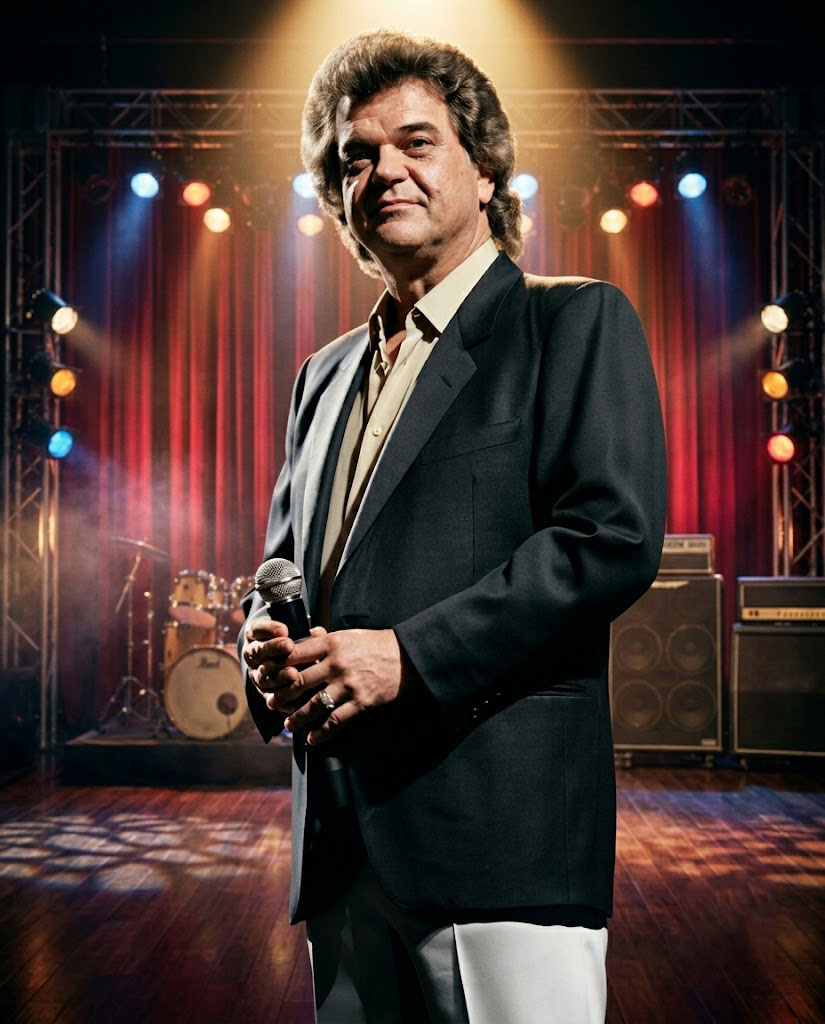
Onstage, he could appear almost still under the warm lights, his face controlled, his voice steady. But the stillness never felt empty. It felt like a man holding back more than he showed, trusting the audience to understand what he would not explain.
That was Conway’s power.
He made loneliness sound familiar.
Not theatrical loneliness. Not the kind written to impress anyone. The kind that follows a person back to the motel room after applause has faded. The kind that sits in the passenger seat on a long drive home. The kind that hears one name and goes quiet.
“Hello Darlin’” became unforgettable because it gave listeners a scene they already knew. Someone returns. Someone remembers. Someone tries to sound casual while standing in the ruins of what used to be.
No one needed a long story.
The first two words told enough.
Later, alongside Loretta Lynn, Conway gave country music another kind of ache. Their duets, including the Grammy-winning “After the Fire Is Gone,” carried the tension of people drawn together by feeling they could not fully defend. Together, they sounded like love and consequence sitting at the same kitchen table.
No halos.
No easy answers.
Just people.
That is why Conway Twitty’s music still reaches across years. His songs did not pretend the heart was simple. They understood that love can be tender and unfair at the same time. That a person can mean well and still leave a scar. That sometimes the softest greeting carries the heaviest history.
When Conway died in 1993, he was still on the road, still giving his voice to rooms full of people who came to hear their own memories returned to them.
And they did.
They still do.
Somewhere tonight, a radio plays that first quiet line, and someone old enough to know better feels their breath pause. Not because the song surprises them, but because it remembers for them.
Maybe that was Conway’s gift: he could turn two ordinary words into the sound of everything we never got to say…