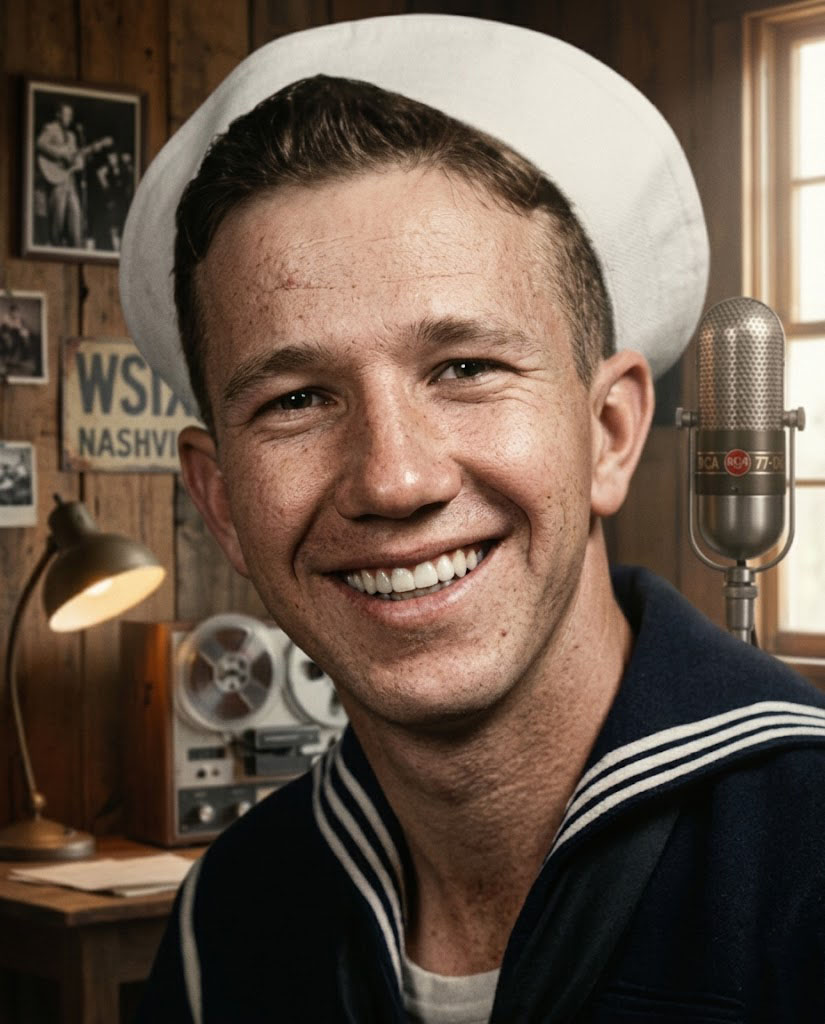
“I’M GONNA BE A COWBOY SINGER ONE DAY” — AND THE BOY FROM GLENDALE WASN’T DREAMING OUT LOUD. HE WAS MAKING A PROMISE…
Before the world knew him as Marty Robbins, he was Martin David Robinson.
A thin Arizona boy, sixth of nine children, growing up in Glendale with more noise than money and more longing than room.
That was where the promise began.
Not on a stage. Not in a studio. Not with anyone important leaning close to listen. Just a boy hearing music and stories in a house where life had already taught him that love could break apart.
After his parents divorced, the home changed.
Some rooms grow quiet in a way children never forget.
Martin learned that silence had weight. It could sit beside him. It could follow him into the evening. But it also taught him how to listen for the small sounds that survived.
His father’s harmonica was one of them.
It drifted through the air with a lonely pull, like something crossing dry land after sunset. Maybe it sounded sad. Maybe it sounded free. To a boy in Arizona, it may have sounded like a road.
Then came his grandfather’s stories.
Cowboys. Outlaws. Frontier towns. Men with honor in their hands and trouble waiting at the edge of the street. Riders who left before morning and did not look back.
Martin did not just hear those stories.
He entered them.
He could feel the dust. He could see the horses. He could imagine the wide country stretching past the last fence, offering danger and escape in the same breath.
Those stories gave shape to something inside him.
Then Gene Autry lit the final spark.
“I’m gonna be a cowboy singer one day.”
It could have sounded like a child’s wish. But some children say things softly because they already know they mean them. Martin was not asking the world for permission.
He was making a promise to himself.
At seventeen, he joined the United States Navy during World War II. The Arizona desert gave way to steel decks, salt air, and ocean nights so wide they must have felt like another kind of frontier.
No cactus.
No dusty road.
Just dark water and a horizon that never came closer.
Somewhere out there, far from Glendale, he picked up a guitar. There was no spotlight waiting. No cheering crowd. No sign that history had stepped quietly into the room.
Only a young sailor trying to turn loneliness into sound.
That is where the promise deepened.
Music became a place to put what he could not say plainly. Homesickness. Memory. The silence of a broken home. The old frontier tales that had followed him across the sea.
He sang because the songs gave him somewhere to stand.
The other sailors may have heard only a young man passing time. A voice in the middle of war. A guitar against the noise of engines and waves.
But inside that voice, something was already forming.
The calm. The ache. The way a story could move slowly and still hold a room. The feeling that every line came from a road longer than the one being sung.
Years later, Martin David Robinson would become Marty Robbins.
The name would change.
The promise would not.
When he finally sang “El Paso,” the world heard a Western tragedy, full of love, jealousy, gunfire, and one last ride back toward Feleena. But under that famous song was something older.
A boy from Glendale listening to his grandfather.
A father’s harmonica fading through the evening.
A sailor under a restless sky, learning how to make silence answer back.
Some dreams are not escapes from childhood — they are the quiet promises a child keeps until the whole world can hear them…