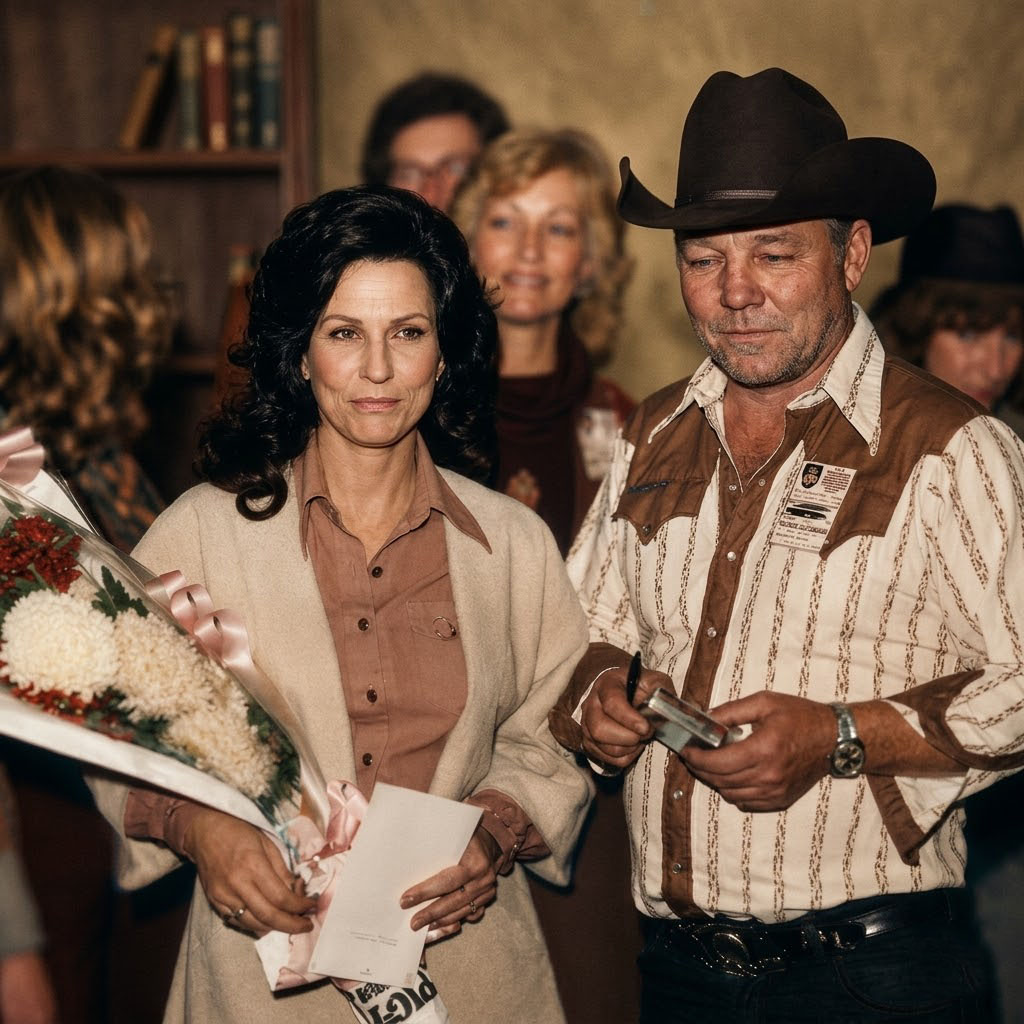
48 YEARS OF MARRIAGE. A THOUSAND REASONS TO WALK AWAY. AND THE DAY SHE STOOD AT HIS GRAVE TO CONFRONT THE UNTHINKABLE TRUTH…
On August 22, 1996, the world quietly assumed Loretta Lynn was finally free.
She stood in the quiet breeze of Hurricane Mills, Tennessee, looking down at the freshly turned earth. The dirt now held her husband, Oliver “Doolittle” Lynn. He had died just five days before his seventieth birthday.
For nearly five decades, friends, fans, and strangers had watched him break her heart, constantly waiting for her to leave.
But standing there at age sixty-four, she didn’t celebrate her independence. She spoke the heavy words that a lifetime of brutal fighting had always kept buried.
“Without Doo, there would have been no Loretta Lynn.”
Her music had always been a public diary of a very private pain.
She was Loretta Webb, the coal miner’s daughter from Butcher Hollow, Kentucky, dragged across the country to a cold town where she knew absolutely no one.
Married at fifteen. A mother of four by twenty-one.
For years, millions of fans listened closely as she turned her bruised reality into gold records. She sang boldly about his drinking, his blatant cheating, and the lonely nights she waited up with a fist full of righteous anger.
Everyone outside that complex marriage saw a reckless man who hurt her in ways no woman should ever be forced to carry.
She became the undisputed voice for tired, trapped, and fiercely stubborn women across America.
THE UNSEEN DEBT
But the absolute truth of Doolittle Lynn could never fit neatly inside a single country song.
Beneath the betrayals and the shattered promises, there was one stubborn, undeniable fact that she simply could not erase.
He believed in her long before the world even knew her name.
It all started in 1953, deep inside a dusty Sears Roebuck.
Doolittle spent seventeen dollars he couldn’t afford on a cheap, simple Harmony guitar. He bought it just because he heard her humming as she washed the dishes, and something in his rough, unpolished heart recognized pure greatness.
That wooden guitar did not magically fix their broken marriage. It certainly did not make him a gentle, loving man.
But it forced open a door that would ultimately change country music history.
Years later, it was Doolittle who practically shoved her onto a stage when she was terrified and pleading to stay hidden in the shadows.
It was Doolittle who arrogantly bragged to skeptical bandleaders that his timid wife was the greatest singer alive.
He relentlessly mailed her first record to three thousand radio stations, hustling straight out of the trunk of their beat-up car on dark highways.
He was a relentless storm that tore through her life.
Yet, he was also the only reason she ever learned to fly.
Loretta Lynn never pretended her husband was a saint.
She didn’t suddenly rewrite their painful history just because he was finally gone. She possessed the rare, quiet courage to hold two contradicting truths in the exact same hand.
He caused her the deepest pain a woman could feel, but he also handed her the entire future.
Their marriage was never meant to be a beautiful fairytale.
It was painfully, brutally human. It was hopelessly tangled in bitter debt, permanent damage, and an undeniable, messy love.
As she looked down at his grave, she didn’t just see her tormentor. She saw the whole man.
Some debts are settled with money, but the ones that truly matter leave a scar you end up carrying for the rest of your life…