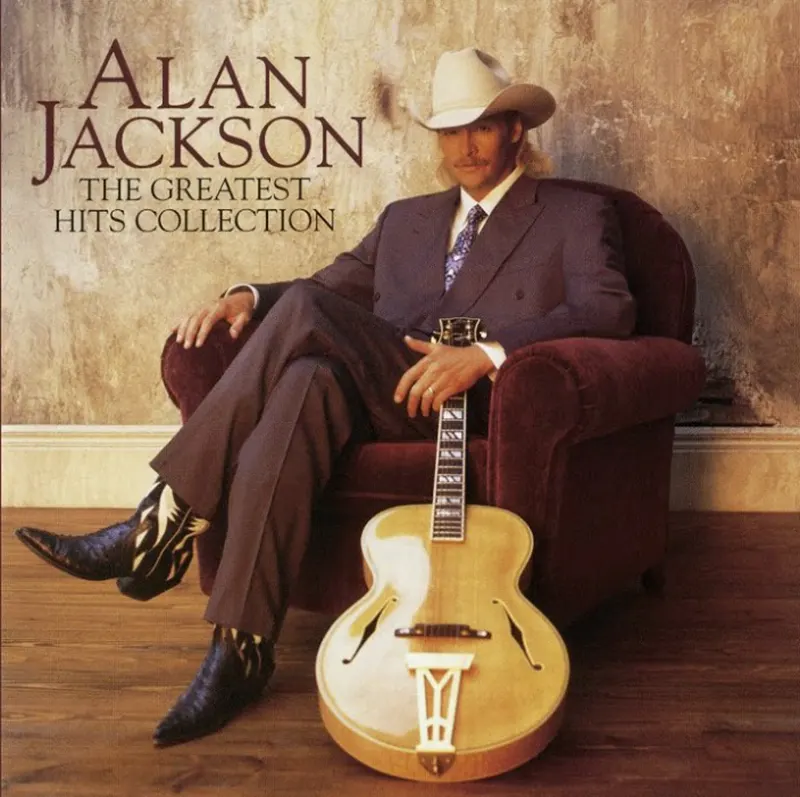
ALAN JACKSON DIDN’T NEED A BIG MOMENT TO BREAK YOUR HEART — JUST A QUIET PROMISE SUNG SOFTLY TO THE END.
There are songs that arrive like fireworks.
And then there are songs like “Till the End.”
They don’t rush into the room. They don’t beg for attention. They simply sit down beside you, lower their voice, and say the thing most people are too proud, too wounded, or too afraid to say out loud.
Alan Jackson has always understood that kind of country music.
Not the kind dressed up to impress strangers. The kind that sounds like porch light, old photographs, Sunday drives, and a man standing in the kitchen after everyone else has gone quiet.
By the time he recorded “Till the End” with Lee Ann Womack, Alan was already one of the steady voices of American country music. He had sung about small towns, working people, young love, grief, faith, and time passing faster than anyone wanted to admit.
But this song was different.
It did not feel like a hit chasing the radio.
It felt like a vow.
“Till the End” had first belonged to Vern Gosdin, a singer who knew how to make heartbreak sound almost too honest to survive. When Alan and Lee Ann brought it back years later, they did not try to outsing the ache inside it.
They respected it.
That is what makes the duet so powerful. Alan’s voice comes in plain and grounded, with that familiar Georgia calm that never seems to force emotion. Lee Ann answers with a tenderness that feels fragile without ever sounding weak.
Together, they do not perform love as something shiny.
They sing it as something tested.
There is a special kind of pain in a song about loving someone even when the road has turned hard. Not the young, easy kind of love that believes nothing can touch it. But the older kind — the kind that has seen disappointment, silence, distance, and still somehow keeps a chair pulled out at the table.
That is where Alan Jackson has always been strongest.
He can make a simple line feel like a lifetime.
He does not need to decorate the hurt. He lets it stand there in its work boots, holding a cup of coffee, staring out a window at something it cannot fix.
And Lee Ann Womack, with her pure country ache, gives the song its echo. She makes it feel like there are two people in the room, both carrying the same memory from opposite sides of the heart.
The beauty of “Till the End” is that it does not promise love will be easy.
It only promises love will remain.
For many listeners, that is the part that catches in the throat. Because somewhere in that melody, people hear their own lives — a marriage that lasted through hard years, a love that didn’t get the ending it deserved, a goodbye that never really stopped loving, a name still remembered when the house gets quiet.
The song does not shout.
It stays.
And maybe that is why Alan Jackson was the right voice for it.
He has built so much of his career on songs that feel less like entertainment and more like something passed down. A father’s advice. A husband’s memory. A small-town summer. A prayer whispered after bad news. A radio playing while someone drives home alone.
With “Till the End,” he reminds us that country music is often at its deepest when it is not trying to be clever.
Just honest.
Just human.
Just brave enough to say: even if I never see your face again, some part of me will keep loving you.
That is the line that lingers after the music fades. Not because it is dramatic, but because it sounds like something real people carry quietly for decades.
A promise folded into a drawer.
A picture kept in a wallet.
A song turned up in the car because, for three minutes, it brings someone back close enough to feel.
Alan Jackson and Lee Ann Womack did not simply cover “Till the End.”
They gave it a second life for people who understand that love is not always loud, and devotion is not always perfect.
Sometimes it is just two voices, one old country melody, and the ache of a promise that refuses to disappear.
And long after the last note falls away, the song keeps doing what the best country songs do.
It finds the place in you where someone still lives.