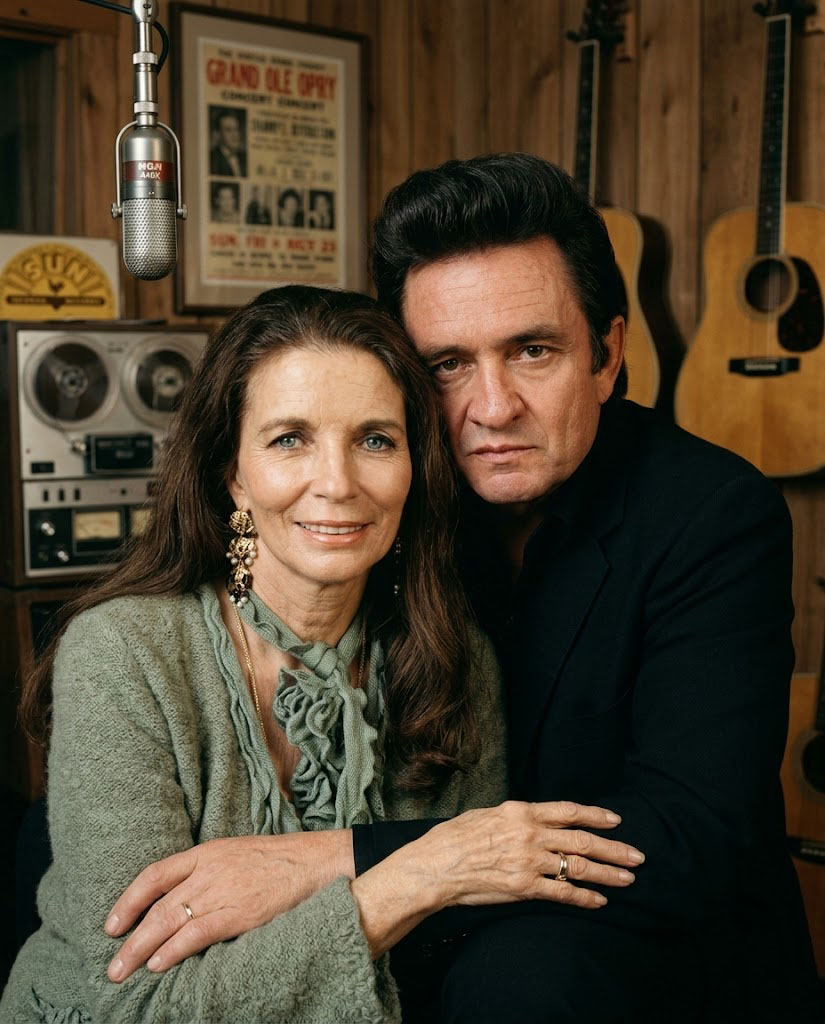
JOHNNY CASH COULD HAVE DRESSED LIKE A KING — BUT HE CHOSE TO WEAR THE WORLD’S PAIN IN BLACK UNTIL THE DAY HE DIED…
By the time Johnny Cash became one of the most famous musicians in America, he could have worn anything he wanted.
Bright rhinestone suits.
Gold jewelry.
The polished glamour that fame so often wraps around its stars.
Instead, he kept reaching for black.
Black shirt.
Black coat.
Black boots.
It became so familiar that people stopped thinking of it as clothing and started understanding it as something deeper.
A promise.
Johnny Cash once explained that he wore black for the poor and the beaten down. For prisoners. For soldiers returning home wounded in ways nobody could see. For people living on the hungry side of town while the rest of the world looked away.
Those words mattered because Johnny Cash knew hardship personally.
Before the records and sold-out stages, he was a boy in the Arkansas cotton fields. He understood hard labor. Empty pockets. Silence heavy enough to settle over an entire family. The people he later sang about were not strangers to him.
They were home.
That connection followed him even after fame transformed his life. Johnny Cash could stand before presidents one night and walk into Folsom Prison the next without changing who he was. He never sang to inmates like they were beneath him.
He sang to them like men still worth seeing.
That was rare.
Especially in an industry often built on image and distance.
But the darkness Johnny Cash carried was not only about the world outside him. Some of it lived inside him too.
Fame did not save him from addiction. Pills nearly swallowed whole years of his life. There were moments when it looked as though even his enormous talent might disappear beneath exhaustion and self-destruction.
Then came June Carter.
Their love story never felt polished or mythical in the usual celebrity sense. It felt fought for. Hard-earned. Johnny later admitted openly that June saved his life.
Not metaphorically.
Literally.
That honesty became part of what made him so powerful to audiences. Johnny Cash never pretended to be cleaner, wiser, or stronger than he truly was. He carried his flaws publicly, almost stubbornly, and somehow that vulnerability only deepened people’s trust in him.
Years later, when much of the music industry had quietly moved on, many people viewed him as a relic from another era. Radio had changed. Trends had changed. Younger stars filled the spotlight.
Then Johnny Cash recorded “Hurt.”
And suddenly the entire world went silent again.
The song did not feel like a comeback engineered for relevance. It felt like an older man sitting alone with every regret, memory, addiction, and loss he had survived long enough to carry.
His voice had grown thinner by then.
Fragile.
But that fragility became devastating.
When Johnny sang, “What have I become?” listeners did not hear performance. They heard a lifetime.
The music video only deepened the wound — old footage, fading photographs, empty rooms, June beside him near the end of their years together. It felt less like entertainment and more like a man opening the final pages of his soul in public.
And people understood instantly.
Johnny Cash was not trying to protect his legend anymore.
He was telling the truth.
That may be why he still matters so deeply now. Not simply because he sold millions of records or entered halls of fame. Plenty of artists achieve success.
Very few remain human while carrying it.
Johnny Cash never stopped standing beside the forgotten. The prisoners. The addicts. The lonely. The people polite society preferred not to discuss too loudly.
He wore black because he believed the world’s suffering should not be ignored.
And even after becoming a legend carved permanently into American music history, he never walked away from those shadows.
He walked straight into them carrying a guitar instead…