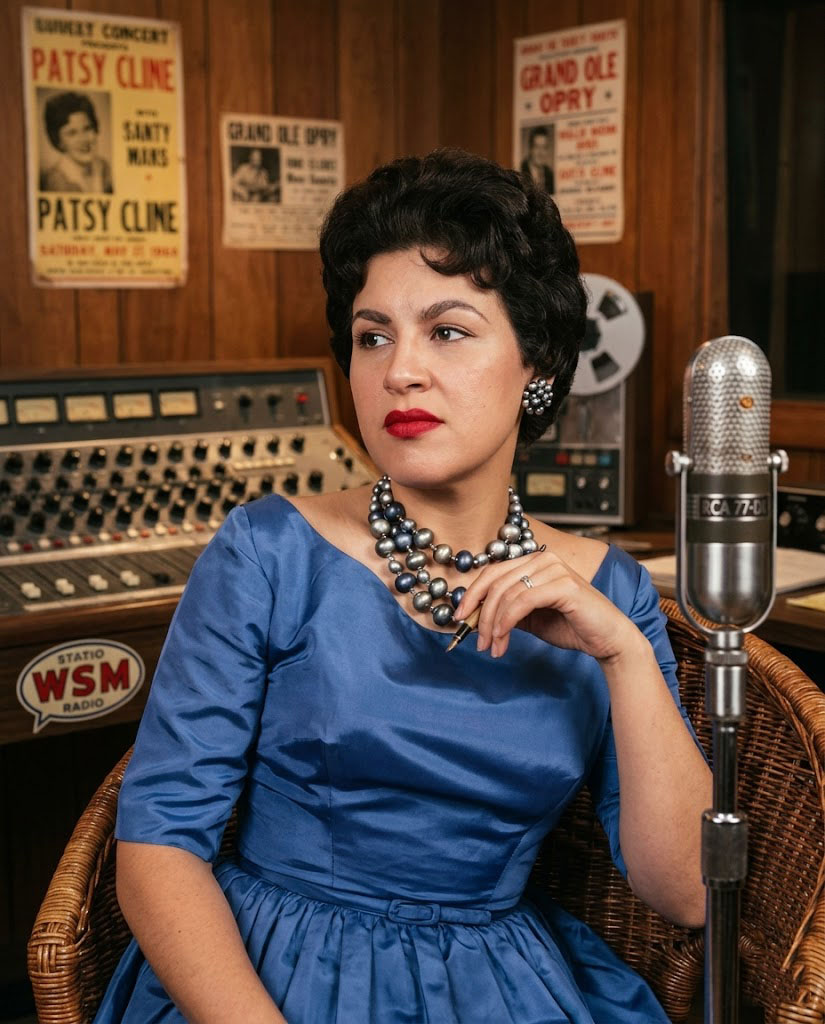
SHE ALMOST WALKED AWAY FROM THE SONG THAT WOULD MAKE HER IMMORTAL — AND THEN PATSY CLINE SANG IT ON LIVE TELEVISION…
In January 1957, Patsy Cline stepped onto the stage of Arthur Godfrey’s Talent Scouts wearing an elegant cocktail dress instead of the fringed cowgirl outfit she normally preferred.
Then she began to sing “Walkin’ After Midnight.”
By the time the performance ended, the audience exploded into applause. She won the competition that night.
But something even bigger had happened.
America had just heard the voice that would change country music forever.
The strange part is that Patsy Cline never truly wanted to record the song in the first place.
To her, “Walkin’ After Midnight” sounded too polished. Too pop. Patsy wanted steel guitars, hard country arrangements, and songs that carried the rough edges of real heartbreak. She came from Virginia honky-tonks, not glamorous television stages.
But her record label pushed for compromise.
And history quietly walked through the door because of it.
The song itself was simple. A lonely woman wandering city streets after midnight, searching for someone who may never return.
Nothing dramatic.
No shouting.
No grand speech about pain.
Just loneliness moving slowly under streetlights.
That restraint became its power.
When Patsy Cline sang, “I go out walkin’ after midnight,” she did not sound theatrical. She sounded tired in the most beautiful way. Like someone trying to stay graceful while carrying heartbreak through the dark.
She made loneliness sound elegant.
That was rare.
Country music already had sadness, but Patsy carried something different inside her voice. There was sophistication in it. Warmth. A kind of emotional control that somehow made the feeling hit even harder.
She never begged listeners for sympathy.
She simply opened the door and let them stand beside her for three minutes.
The performance on Talent Scouts changed everything almost overnight. Viewers flooded the program with attention. Radio stations began spinning the song heavily. Soon, “Walkin’ After Midnight” climbed both the country and pop charts, turning Patsy Cline into a national name.
It became her first major hit.
The song she nearly passed on became the song that introduced her to the world.
That moment mattered far beyond one chart position. In the late 1950s, country music and pop music still lived in separate rooms most of the time. Patsy Cline walked comfortably between them without abandoning either side.
She could sound polished without losing honesty.
That balance became revolutionary.
And underneath it all was the voice itself — rich, controlled, and unmistakably human. Patsy could stretch a simple line into something cinematic. She could make silence between words feel important.
Even now, decades later, very few singers can touch the emotional precision she carried so naturally.
What makes “Walkin’ After Midnight” endure is not only the melody or the success story surrounding it. It is the feeling hidden inside the performance.
The song understands loneliness without collapsing under it.
There is still movement in it.
Still hope.
The woman in the lyric keeps walking.
That matters.
Especially knowing what came later. Patsy Cline’s life would end tragically in a plane crash in 1963 at only 30 years old, leaving behind a career that somehow still feels unfinished despite how legendary it became.
But “Walkin’ After Midnight” remains frozen in that first breakthrough moment — before the tragedy, before the mythology, before the world fully understood what her voice could do.
A woman standing beneath television lights.
One microphone.
One song she almost rejected.
And a room suddenly realizing they were hearing something they would never forget.
Maybe that is why the record still lingers long after midnight.
Because every time Patsy Cline starts singing, it feels less like a performance and more like someone quietly walking beside us through the dark, refusing to let loneliness have the final word…