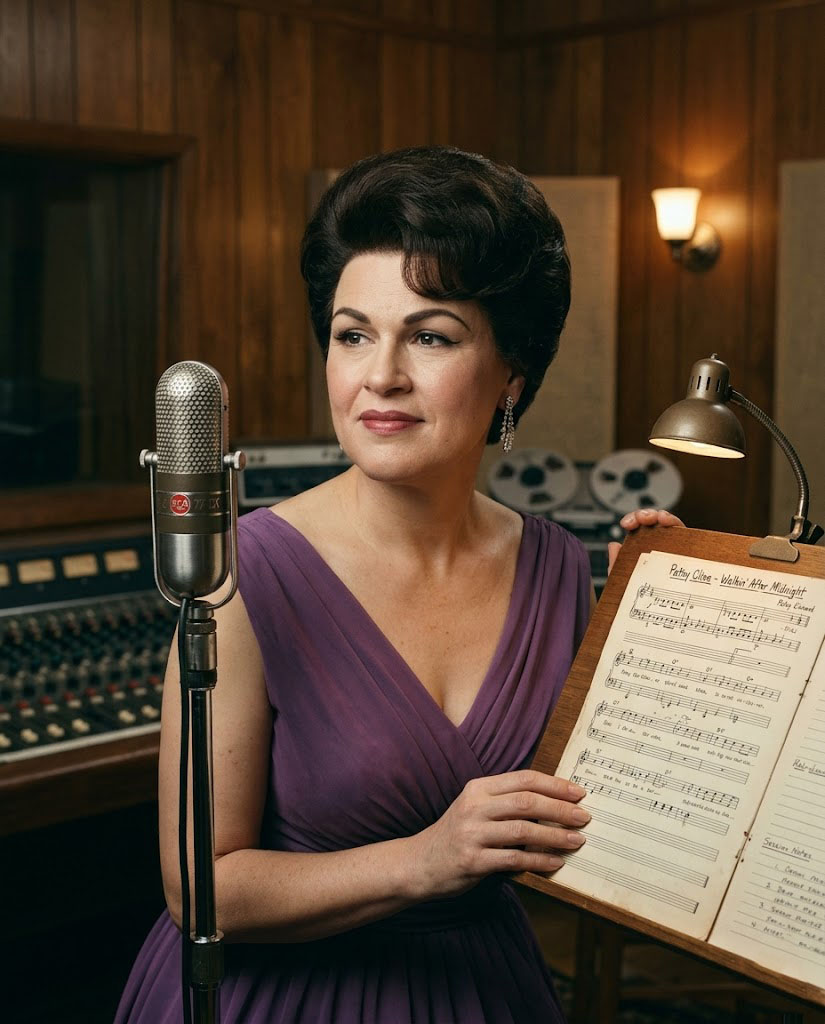
WEEKS BEFORE HER DEATH, PATSY CLINE RECORDED “SWEET DREAMS” — NEVER KNOWING IT WOULD SOUND LIKE HER GOODBYE TO THE WORLD…
In early 1963, Patsy Cline walked into a Nashville studio to record “Sweet Dreams.” The song carried sweeping orchestration and polished pop arrangements that she never fully loved.
She was country to the bone.
But when the microphone turned on, none of that mattered anymore.
Because Patsy Cline sang the song like she already understood loss too well.
The recording session itself was calm, almost ordinary by industry standards. No dramatic argument. No sense that history was quietly unfolding inside the room.
Just Patsy standing still before the microphone, shaping heartbreak into something timeless.
“Sweet dreams of you…”
The words barely rose above a whisper at first.
That was part of her power.
Patsy never needed to overpower a lyric. She could soften her voice instead, letting sadness settle slowly into every corner of a song until listeners stopped hearing music and started hearing themselves.
And “Sweet Dreams” gave her the perfect space for that kind of honesty.
The song was about longing that refuses to disappear. About a love that continues living inside memory long after reality has already moved on. There was resignation in the lyric, but not bitterness.
Only ache.
Patsy understood that emotion instinctively.
By 1963, she had already become one of the defining voices in country music. “Walkin’ After Midnight,” “I Fall to Pieces,” and “Crazy” had transformed her into a national star capable of crossing between country and pop without losing emotional truth.
But success had not polished away the humanity in her voice.
If anything, it deepened it.
She still sounded like someone carrying scars beneath elegance. That balance made her different from nearly everyone else on the radio. Patsy could make heartbreak sound graceful without making it feel distant.
That was rare.
Especially in “Sweet Dreams.”
The lush strings behind her may not have matched the raw country sound she naturally preferred, but Patsy found a way to pull the song back toward something personal. Beneath the orchestration was loneliness. Real loneliness.
The kind people try not to admit out loud.
When she leaned into certain lines, there was a heaviness underneath the control. Not theatrical grief. Not exaggerated sorrow.
Just quiet acceptance.
And somehow that hurt more.
Then, only weeks later, everything changed.
On March 5, 1963, Patsy Cline died in a plane crash near Camden, Tennessee. She was only 30 years old. Alongside her were fellow country performers Cowboy Copas and Hawkshaw Hawkins.
Country music lost one of its clearest voices in an instant.
The tragedy froze Patsy in time. Young forever. Mid-career. Still evolving. Still becoming something even larger than the industry already believed possible.
When “Sweet Dreams” was finally released after her death, listeners heard it differently.
It was no longer simply another Patsy Cline single climbing the charts.
It sounded like farewell.
Not because the song mentioned death or endings directly, but because every line now carried the weight of absence. The longing inside the lyric suddenly felt larger than romance itself.
People were not only mourning the woman in the song.
They were mourning the woman singing it.
And that transformed “Sweet Dreams” into something almost impossible to separate from Patsy’s legacy. Even now, decades later, the recording feels suspended in a strange emotional space between beauty and grief.
A voice still reaching toward something it can never fully hold.
Maybe that is why the song continues to linger long after the final note fades.
Because Patsy Cline did not just sing about broken dreams.
She made listeners feel how fragile hope really is when life leaves the room too soon…